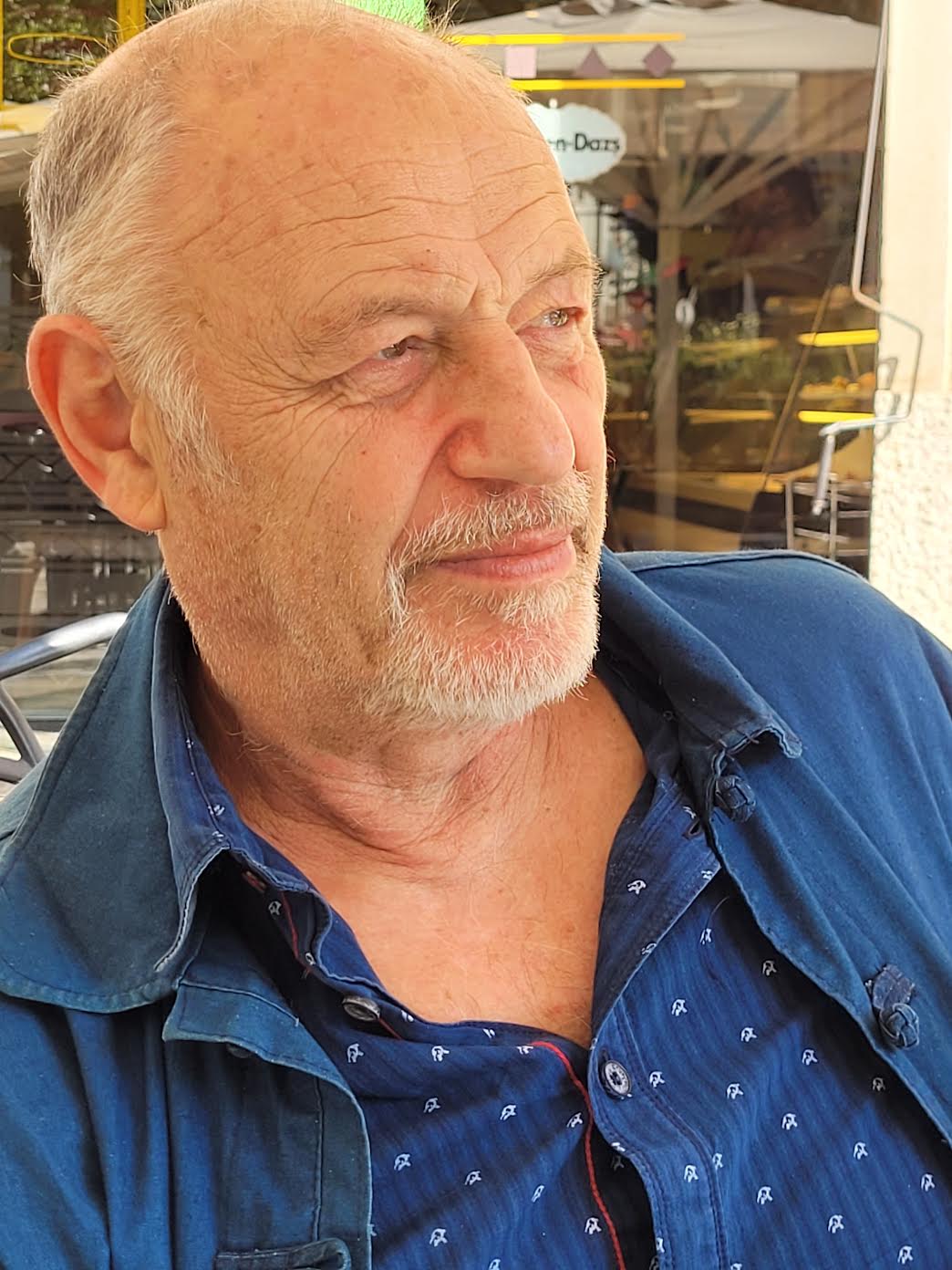


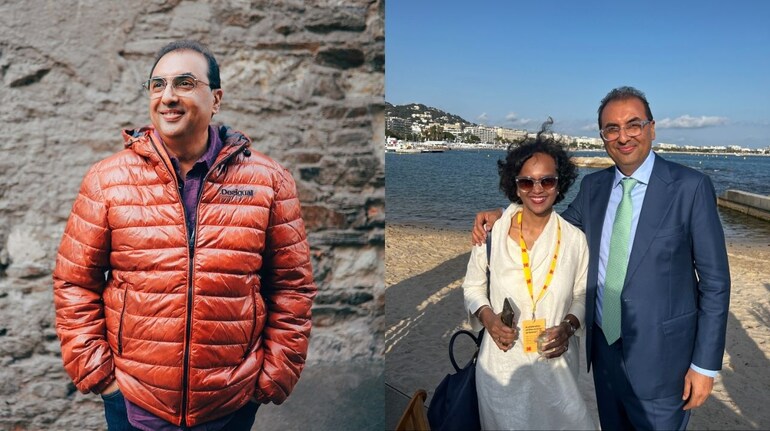
Shivendra Singh Dungarpur, the newly appointed Director of the MAMI Mumbai Film Festival, shares his vision and plans for this year's event. Under his leadership, MAMI will showcase a diverse range of films, focusing on South Asian cinema, independent films, and restored classics. In conversation with Moneycontrol.com, Dungarpur emphasises MAMI's commitment to empowering young filmmakers and maintaining the festival's core spirit of celebrating diverse and regional Indian cinema.
To begin with, could you run us through the key highlights of MAMI this year?
I've just taken over as the Director at MAMI this year. We are basically in two venues, Regal and Juhu PVR. Of course, the main highlight is the South Asian Competition, where we have some amazing films. If you look at the programming, you have the non-competition section, you have Master Classes, you've got the Payal Kapadia film (All We Imagine as Light) as the opening film. You've got Shabana Azmi getting the Award for Excellence in Cinema. And then `we've continued the tradition of the restored classics.
What is amazing is that you've got films from all over India, from different parts of India - it's great to have that kind of range. You've got the opening and closing with the two big winners at Cannes. The opening is, of course, Payal Kapadia's film and the closing is Anora, which is Sean Baker's film that won the highest prize (at Cannes, Palme d'Or). So, you see the programming lineup is just amazing.
This is one of our big things is to set the tone for what the festival is going to come with (in future). It's the diversity, it's the range, it's the independent cinema. Payal's film represents the struggle to find funds to make a film and then to reach that goal and to win that award (at Cannes). And that's the spirit we're going to continue with MAMI in the years to come.
How is MAMI planning to empower the new and upcoming filmmakers?
Oh, yeah. I mean, the platform, look at it, look at the programming. We've also got Royal Stag Large Short Films. Last year, MAMI had tied up with Apple to find five filmmakers, young filmmakers and empower them. And if you look at the number of young filmmakers who are getting applause and awards all over India, I think MAMI is representing all those films. I mean, just look at the South Asian Competition. And why just in India? We are also talking to our neighboring countries, which are so important. The thing that you grow and you make our youngsters realise the importance of the films they're making and empower them is through a global perspective, through a South Asian perspective, through a neighboring country perspective. You have a film like Pedro Almodóvar's film, which is representing a great master whose film is winning in Venice, in other places - it's being shown in the World Cinema section. And then you have an independent section, which is competing. That diversity, that kind of range is beautiful.
A lot of people ask me this question. What is different with MAMI? I said, "This year it's better. The reason is that we've got great programming, very tight programming." Secondly, what is a festival? A festival is that you are in a limited space, you are all together. People come out, people go in, you meet the filmmakers, you are able to discuss... You're not struggling from here to go to Goregaon to find the filmmaker. This is essentially what we would like to do. It's not about whether we had less funding or we are different than last year. I think we're going into an ideal situation, what the festival should be.
This is the first time MAMI will not have a title sponsor since 2014. How could this impact the festival?
Is there any festival in the world where you see a title sponsor? Name one festival. Is the Cannes Film Festival called something else? Is the London Film Festival or the New York Film Festival called something else? Why should MAMI have that? MAMI will have support and funding from other sources, but it will be an entity of its own. It's too big. MAMI represents the essence of what Mumbai is. It represents not only Mumbai, but it represents our country in many ways. Mumbai represents diversity. The people in this city are from every region, every nook and corner. And that's what we want MAMI to represent. I don't think we're ever going to have a title sponsor (hereon). Never. We will have support. We will have funding. But the name of MAMI will remain MAMI. Watching films and celebrating cinema, you know.
I run the Film Heritage Foundation. I've been showing films free of cost at all the venues. Have you ever seen it getting affected by just showing films? Never. It's only the kind of things you want to do, sort of, get affected by that, but we will find a form. Because once you start a path, where you are trying to empower young filmmakers, which is such a beautiful path, which anyone would agree is the right path to take... It is good to have hardships, no? You're finally empowering those people who normally will not get funding. And that is what the Film Heritage Foundation does, preserving and restoring films, which normally nobody does. Should I be restoring a film of a big filmmaker whose film has done 100 crores? Certainly not. I'd rather do a film which the person is finding hard to restore.
Same way, what is the festival about? Showing you those films, which cannot be seen any other way, but here. But if I show a film which is releasing after two days, it will not have the same value because the festival is not that. We might do a few galas like that, a few attractions like that, like how Cannes does, or Venice does, or Berlin does. They show big Hollywood films and all that. But certainly the main core of the festival will be what you asked, empowering the young and the regional filmmakers, the people from different parts, whether it's Marathi, whether it's Kannada, whether it's Telugu, whether it's Manipuri or anything else. I think their films, which are the true films of India, our regional cinema, is where the cinema lies. And that's where India lies. And we've got to showcase that.
Celluloid Man is one of the few Indian films to have been selected for such a high number of festivals. While you were working on the documentary, did you already envision the film to make such an impact?
No. You see, all my films have gone to many festivals. My third film is the longest film ever censored. It's called CzechMate: In Search of Jiří Menzel. It's a seven hour long film. Whenever I make a film, and I think that's essentially where I sort of evolved myself out, is that I enjoy the journey and the process. The outcome is what I never look at. I always think, "Have I enjoyed that process? Have I enjoyed making it? Have I learned something? Have I gone through a process?" For me, that journey has to be very exciting. Then the result is just organic.
I never entered Celluloid Man into any festival, unlike my restored classics. Celluloid Man just organically went from festival to festival, festival, because I think it was important when it got released in 2012. It spoke about something which people didn't know. It was discovering the heritage of Indian cinema, the true essence of what Indian cinema is. How many films are lost, what films survive.... It tracked the history of Indian cinema for the first time.
And I think people got to know very interesting facts about films from different regions. And it was also a discovery for me, which led me to start the foundation. Had I not made Celluloid Man, which I never intended to be a film, I think I would have never started the foundation and embarked on the journey because I was already a very successful ad filmmaker. I was making big commercials and many films. And I wanted to find my journey and find my way of looking at life. And now I've devoted my entire life to cinema.
What do you find so gratifying about cinema?
The most gratifying role, which I think of myself, is showing films to people. Showing films and being accessible. The biggest joy for me is walking into a movie theater, sitting like the same kid I was when I entered and saw a film as a child, looking up onto the screen larger than life and laughing and enjoying, seeing the film with the public at large. For me, cinema is a religion, a temple, the only temple where all people from all castes - there is no bar on that, just come to celebrate life. Cinema is life. You really see life depicted in front of you, next to you, behind you, around you. So there's no bigger joy than showing cinema to people.
When exactly did you get so passionate about cinema?
My passion was fueled by my grandmother and my grandfather. They belong to the royal state. And in their veranda, there used to be a projectionist who would come every day. His name was Chandi Mistry. And he would show us these films on the projector, which would be Chaplin, which would be Buster Keaton, Harold Lloyd...all the great comedians of that generation. And I would be watching films continuously.
And then many times my grandmother would take me to a cinema hall. I think the passion and the love they had for cinema... There were multiple reasons, you know. I used to see my father shoot on Super 8 films and he was making small wildlife films. I used to see the strip of film going into a projector upside down and then being projected straight up, you know, and see Chaplin! That magic of cinema being projected and the images coming on the screen and the light and the kind of joy it brought to people. I think it just connected with me. I am always, as far as cinema is concerned, my energy and my excitement remains, but always like a little boy. I never forget that because cinema to me is what I saw when I was so young.
What are the hidden gems that you have discovered for MAMI?
It's difficult to say because there are so many great films. It would be difficult for me to name one film because when you look at the South Asian Competition, you don't want to give out what the director's perspective at this stage is, because there is a competition. But all the films which are selected in South Asian Competition were all discoveries. Some were known, some came as a surprise to us. And if you look at the programming, we have maintained the balance. This credit goes to the MAMI team for finding a balance between the best of South Asian Cinema Competition and non-competition, but also to continue our tradition with restored classics, which is going to become bigger and bigger. We have Girish Kavali's Ghatashraddha, Mahabharata, Senegalese film, everything....
Are you also in the process of restoring movies of the silent era?
No, not this year. Your question is absolutely fantastic because I would love to do that. I would love to show people the evolution of films in the silent era. And that's why we, this year is a transition year where we are finding our feet, we are finding our ways, and next year you will see the difference.